An editorial reflection on planning, logistics, visual decisions, and field execution — from scouting to final image capture — carried out by an audiovisual team on Ilha do Mel, Paraná, Brazil.
Ilha do Mel is a place where landscape, weather, and human presence coexist in a delicate balance. Protected by environmental regulations and shaped by the Atlantic Ocean, the island offers a visual rhythm that changes constantly throughout the day. For our team, it was the perfect setting for a focused audiovisual production aimed at capturing coastal atmosphere, architectural landmarks, and the relationship between light and territory.
The resulting materials include wide landscape views, elevated coastal perspectives, lighthouse studies, calm sea horizons, and observational details of one of the most iconic locations in southern Brazil.
Understanding the Location
Ilha do Mel is not a conventional production environment. There are no cars, limited infrastructure, and strict environmental preservation rules. Every piece of equipment, every movement, and every hour of work must be planned in advance.
From the beginning, our intention was clear: to produce a cohesive visual collection that could function both editorially and commercially, without interfering with the natural dynamics of the island.
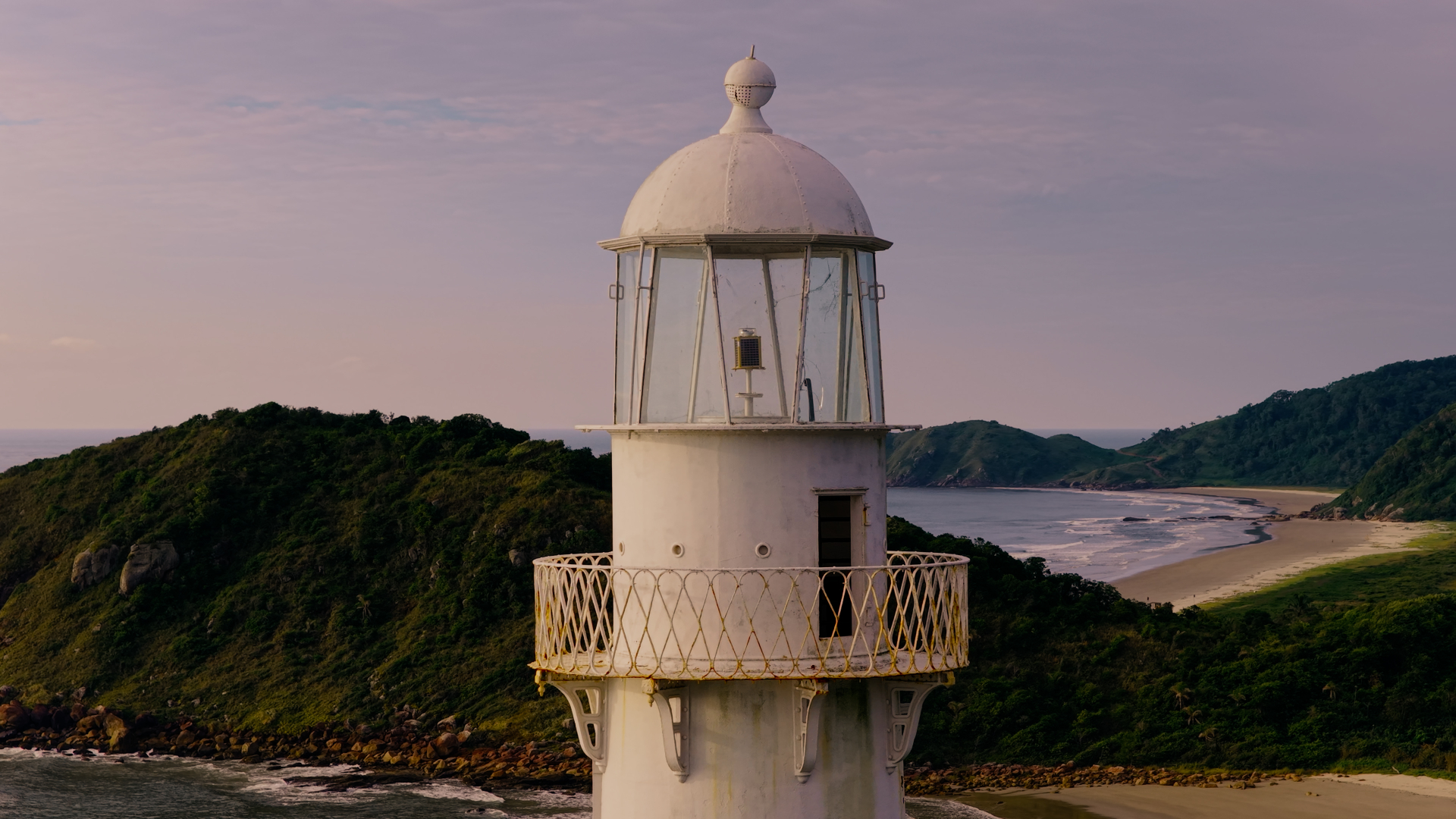
The Farol das Conchas (Conchas Lighthouse) became a central visual anchor for the project. Visible from different points of the island and positioned on elevated terrain, it naturally offers variations in angle, distance, and context — from close architectural details to wide shots integrated with the coastline and ocean.
Rather than treating the lighthouse as a single subject, we approached it as a narrative element, allowing it to appear differently depending on time of day, light conditions, and camera position.
Pre-Production and Visual Planning
Concept Definition
Before arriving on the island, the team developed a visual outline based on three main pillars:
- Geographic clarity — The images needed to clearly communicate location: southern Brazil, Atlantic coast, Ilha do Mel.
- Atmospheric consistency — Calm seas, soft light, and natural color palettes were prioritized over dramatic weather or extreme contrast.
- Editorial flexibility — Each asset needed to stand alone while also working as part of a larger visual set — suitable for web, broadcast, and stock usage.
Mood references were intentionally minimal. Instead of replicating existing imagery, we focused on observational realism, allowing the island to guide framing and pacing.
Scouting and Timing
Scouting was conducted both remotely and on location. Tidal charts, sunrise and sunset times, and historical weather patterns were reviewed in advance.
Once on the island, the team spent the first day walking the main trails, mapping:
- Natural elevation points
- Clear sightlines toward the lighthouse
- Safe drone takeoff and landing areas
- Positions with unobstructed ocean horizons
This initial scouting phase was essential. Ilha do Mel changes quickly — vegetation, humidity, and light conditions can alter the same scene within minutes.
Team Structure and Roles
Although compact, the five-person team operated with clearly defined roles to ensure efficiency and consistency.
- Director / Lead Photographer — Responsible for visual decisions, framing, and overall narrative coherence.
- Camera Operator / Video Specialist — Focused on motion capture, slow movements, and stabilized sequences.
- Drone Pilot — Managed aerial perspectives, elevation control, and coastal tracking shots while respecting local regulations.
- Production Assistant — Handled logistics, equipment transport, and environmental monitoring (wind, light shifts, tide).
- Post-Production Supervisor (on location) — Conducted daily reviews, backups, and preliminary color consistency checks.
Even in a natural setting, structure matters. Assigning roles avoided rushed decisions and allowed each image to be captured with intention.
Equipment Selection
Given the island's conditions — humidity, salt air, uneven terrain — equipment choices were conservative and reliable.
Camera Systems
We worked primarily with full-frame mirrorless cameras, chosen for high dynamic range, strong performance in low-contrast light, and weather resistance. Multiple focal lengths were used to ensure visual variety:
- Wide lenses for landscape and context
- Mid-range lenses for architectural balance
- Telephoto lenses for isolated lighthouse details and compressed horizons
Drone Operations
A compact drone system was used for aerial captures, focusing on elevated coastline views, lighthouse positioning within the landscape, and vertical separation between vegetation, land, and sea.
All flights were pre-planned, short, and conducted only under safe wind conditions. The objective was not spectacle, but spatial clarity.
On-Location Production
Working with Light
One of the defining elements of this production was light variation. Instead of forcing a fixed schedule, the team adapted daily plans according to morning haze, cloud density, and reflections on the ocean surface.
Early mornings were dedicated to soft, diffused light — ideal for wide coastal scenes and calm horizons. Late afternoons provided warmer tones, particularly effective for lighthouse silhouettes and elevated viewpoints.
No artificial lighting was used. All scenes rely entirely on natural conditions.
Repetition with Variation
Many of the final assets may appear similar at first glance: the same lighthouse, the same coastline. This was intentional.
Each capture explored a different combination of distance, height, orientation, and atmospheric density. This approach allows the material to function in multiple contexts without visual redundancy.
Environmental Awareness
Ilha do Mel is a protected area, and respecting that status was non-negotiable. The team followed strict guidelines: no off-trail movement, no interference with wildlife, minimal setup time per location, and immediate area restoration after each capture.
Production efficiency was directly tied to environmental responsibility.
The Resulting Visual Collection
The final body of work includes:
- Coastal landscapes with clear geographic identity
- Lighthouse imagery from multiple perspectives
- Calm ocean horizons suitable for editorial use
- Elevated viewpoints connecting land and sea
- Architectural details integrated into nature
Each image was designed to be timeless, avoiding trends or overly stylized treatments.
Post-Production Philosophy
Color correction and grading were intentionally restrained. The goal was not to "enhance" Ilha do Mel, but to represent it accurately.
Adjustments focused on white balance consistency, natural contrast, and preserving detail in highlights and shadows. The final look reflects what it feels like to be there — not an exaggerated version of it.
Final Thoughts
Producing audiovisual content in a place like Ilha do Mel requires patience, observation, and respect for natural rhythm. This project was not about capturing everything, but about capturing enough, with clarity and intention.
By working as a coordinated team, even with a small footprint, we were able to create a visual set that communicates place, atmosphere, and scale — suitable for editorial platforms, commercial licensing, and long-term portfolio use.